When Latin America’s most collaborative tech ecosystem encounters the need for human connection
We just returned from Tech Week Mexico 2025, and one thing became very clear: the Mexican technology ecosystem is not only growing, it is evolving in a profoundly different way.
While many tech hubs around the world operate on a foundation of fierce competition and a “winner takes all” mentality, Mexico is building something different: an ecosystem founded on collaboration, community, and openness. Founders helping founders. Venture capitalists introducing startups to other funds. Companies sharing lessons learned, not just success stories.
This is a highly collaborative culture. And it is precisely in this context that the need for more human tech brands is not only desirable, it is strategic.
The paradox of collaboration in the absence of connection
During the event, we spoke with dozens of founders, product leaders, and brand teams. One pattern kept recurring:
“We know how to collaborate as an ecosystem, but our brands continue to speak as if we were alone.”
What does this mean? That although the Mexican ecosystem has an arousing collaborative culture, many tech brands still operate from obsolete paradigms:
- Landing pages that scream features without explaining why they matter
- Communication that talks about “solutions” but not about real human problems
- Visual identities that are so similar to each other that they could be swapped without anyone noticing.
- Narratives that celebrate technology, not the people who use it
There is a disconnect between how the ecosystem operates (collaborative, human, open) and how brands present themselves (transactional, generic, cold).
Why Mexico has the opportunity to lead something new
If there’s one thing that characterizes Mexican culture, it’s its warmth and humanity. The ability to create genuine connections. To build trust through closeness, not corporate distance.
This cultural advantage is precisely what the tech world needs now.
Think about it: at a time when AI is commoditizing features at an unprecedented rate, where any startup can replicate your product in months, what really sets you apart?
Your humanity. Your ability to connect. The depth of your brand.
And Mexico, as an ecosystem, already has that DNA. It just needs to be applied to how we build brands for this new era.
From transaction to transformation: the new brand contract
At Tech Week, we saw fascinating examples of Mexican startups that are doing this well. They don’t just build products, they build movements. They don’t just acquire users, they create communities.
The best tech brands in the ecosystem understand that:
1. Community is strategy, not marketing
In a collaborative ecosystem, your community isn’t just an acquisition channel. It’s the essence of your brand. The companies that thrive in Mexico aren’t those with the most users, but those with the most advocates.
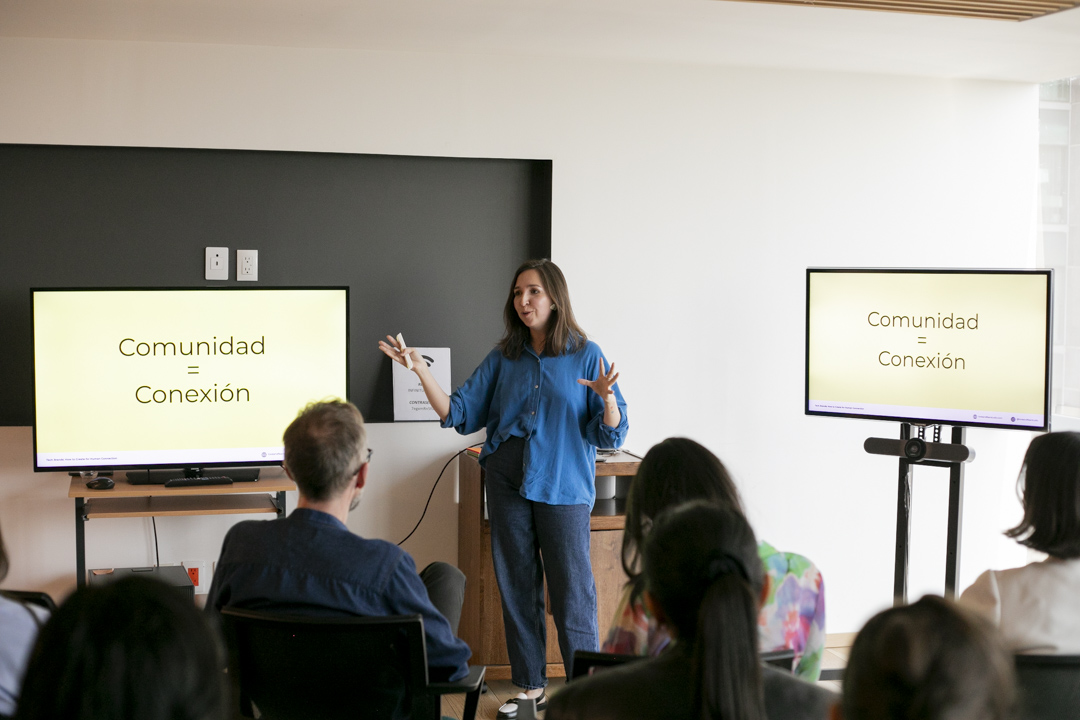
Community = Connection And genuine connection, as Brené Brown reminds us, means “feeling seen, heard, and valued, not just having a large number of superficial interactions.”
2. Vulnerability is power, not weakness
We saw founders sharing their failures with the same openness as their successes. This vulnerability doesn’t make them seem weak; it makes them human. And in a world saturated with narrative perfection and growth at all costs, humanity is what sets them apart.
Mexican tech brands have the opportunity to lead through authenticity. To showcase the process, not just the result. To talk about the lessons learned, not just the achievements.
3. Collaboration requires trust, and trust is built with consistency.
The Mexican ecosystem works because there is trust among its players. That same trust must exist between your brand and your users.
Trust isn’t built with a brilliant pitch deck or a viral campaign. It’s built day by day, with consistency in:
- How you speak (tone of voice, communicating beyond the product)
- How do you see yourself (visual identity, create something of your own)
- How you work (user experience, design an emotional journey)
- How do you respond when something goes wrong (error states, customer support, transparency, reduce sources of stress)
The cost of not going deeper
Something I often hear is, “Now we need to grow, the brand can wait.”
This is a false dichotomy. Today, your business and your brand are on the same wavelength; they are inseparable.
It’s not brand investment vs. growth. It’s sustainable growth vs. fragile growth.
When you build without brand depth:
- You only compete on features (that are copied)
- You compete only on price (which is a long-distance race)
- Your churn rate is high (because there is no emotional loyalty)
- Your CAC keeps rising (because you don’t have organic word-of-mouth)
- Your team doesn’t know how to articulate why what they do matters.
When you build with brand depth:
- You create defensible differentiation
- You generate loyalty beyond convenience
- Reduce your CAC because your users recommend you
- You attract better talent (because the mission is clear)
- You are more attractive to investors seeking long-term value.
What does it mean to go deeper?
Mauro Porcini, Chief Design Officer at Samsung, says it better than we can:
“At the heart of every great idea, every innovation, every act of progress, there are always people. But not just any people. The true force that moves the world is people who love people: those who design, create, build, and imagine with others in mind. Those who see empathy not as a soft skill, but as the ultimate superpower.”
Going deeper means building from a place of love for the people who will use what you create.
It’s not about hiring an expensive agency or doing a rebrand every year. It’s about constantly asking yourself:
What is your brand really about?
Not the features response. The human response.
We saw brilliant examples of this at Tech Week:
Koltín: Memberships with health insurance for older people (50-84 years), breaking the age barriers of the traditional system
Niko: Solar energy with flexible payment options and no down payment, democratizing access to sustainable energy
Plenna: Comprehensive health for women without prejudice, addressing issues that are traditionally ignored
Do you see the difference?
These brands aren’t selling software. They’re building with empathy as a superpower.
Going deeper means:
- Design, create, and build with others in mind, always.
Not from your technical capabilities, but from the emotional needs of the person who will use it. - View each touchpoint as an act of love or fear.
Does your onboarding make people feel capable or lost? Do your error messages empower them or frustrate them? - Build from empathy as a strategy, not as a slogan.
Map the emotional dimension before the functional one. Ask yourself: What does your user fear? What do they expect? How do they feel at each stage of the journey? - Build a community, not just a data base.
People don’t just want to use your product. They want to belong to something. Invite them to co-create with you. - Be genuinely consistent.
Your brand isn’t your logo. It’s every micro-interaction, every email, every line of code, every customer support response.
The time is now
Tech Week Mexico showed us one thing clearly: the ecosystem is maturing. Investors are more sophisticated. Users are more demanding. Competition is more intense.
But there is also more collaboration, more talent, more capital, and a greater desire to build something that matters.
The leading Mexican tech brands in the coming years won’t be those with the most features or the most advanced technology. They’ll be the ones that achieve something more difficult: creating genuine human connection at scale.
Because in the end, as we saw in every panel, in every hallway conversation, in every networking dinner at Tech Week: people connect with people, not with products.
Technology can be extraordinary. AI can be transformative. Products can be disruptive.
But without humanity, without genuine care for the people who use them, they become empty. Interchangeable. Forgettable.
An invitation
If you’re building a tech brand in Mexico or Latin America, you have a unique opportunity.
You can follow the Silicon Valley playbook: grow fast, optimize metrics, compete on features, raise more capital.
Or you can create something different. Something that reflects the culture of high collaboration and human warmth that already exists in our ecosystem.
You can build tech brands with humanity.
Brands that not only solve problems, but also create a sense of belonging.
Brands that grow not only in users, but also in advocates.
Brands that not only raise capital, but also build communities.
At Love&Fear Studio, we believe that the best tech brands are not built from a fear of being left behind, but from a genuine love for the people who use them.
Mexico has everything it needs to lead this change.
The question is: do you dare to go deeper?
Tech Week Mexico 2025 left us inspired and convinced of one thing: the future of tech brands in Latin America will not be a copy of the Silicon Valley model. It will be something more human, more collaborative, more our own.
What do you think? Are you ready to build differently?
P.S. If you were at Tech Week and this resonates with you, let’s talk. We want to know what you’re building and how we can help.