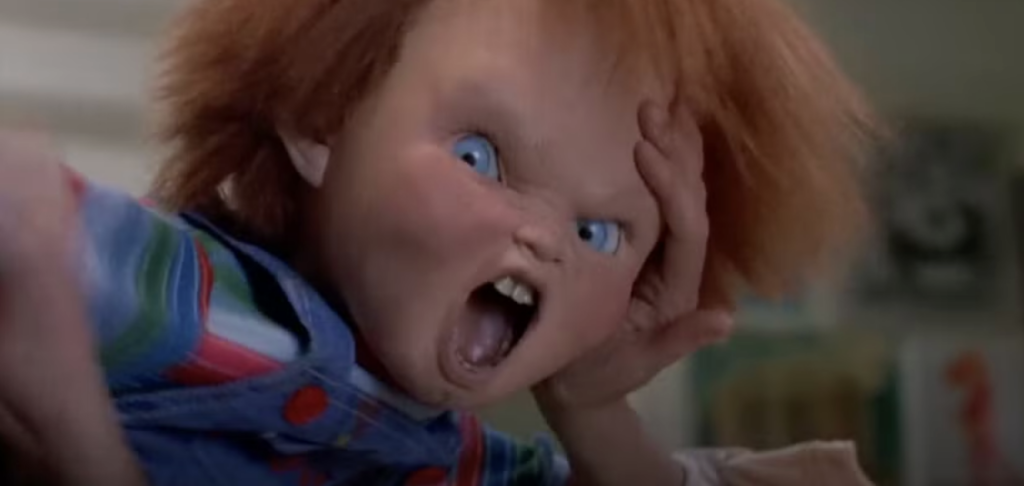
I’m from a generation that grew up watching horror films as a pastime. It was a gathering among friends, an excuse to get closer to some budding romance, a way to break the monotony of the day. How could we not? The Exorcist, Chucky, Nightmare, Friday the 13th provoked something hard to explain: a physical reaction, a slight sweat on the palms, a discomfort that ran through your gut and that, somehow, was addictive. An adrenaline similar to what you feel when the roller coaster car begins to fall.
Covering your eyes knowing you’re going to look anyway. That tension before the hit. That silence that announces something is coming.
Over the years I understood that this sensation had a name: fear. And that it didn’t only live on the screen, but in almost all the important moments of my life.
It wasn’t so fun anymore when I had to present in front of the whole class and didn’t want to fail. When I went into a test without being one hundred percent prepared. When I met my new in-laws at a lunch where I was not playing local.
That’s when you start to discover something key: It’s not that fear disappears, it’s that sometimes the firmest steps are taken with trembling legs.
Perhaps out of survival (like the protagonists of those movies) I got used to facing it. To not running away. To making it part of everyday life. To overcoming it in simple things, every day. And just like me, almost everyone.
I say almost because what’s curious is that when fear stops being individual and starts involving more people (teams, brands, or even entire societies) it seems that facing it is no longer a collective task. It’s easier to turn a blind eye and let it rule. Like someone who doesn’t flee from the villain, but doesn’t confront them either. Like someone who just covers their eyes and hopes the scene ends.
At that point, fear becomes comfortable. And dangerous.
Fear doesn’t usually appear in the briefs. It’s not in the kick-off meetings or in the final presentations. But it’s there. Always.
Fear of losing.
Fear of being wrong.
Fear that the client will get angry.
Fear that the idea won’t be liked.
Fear that the boss won’t like it.
Fear of being judged.
Fear that someone will ask something you don’t know how to answer.
Fear of losing the client.
And yet, endings, resignations, boundaries, letting go and starting from scratch are also achievements. Though it’s hard to see when fear tightens its grip.
Do we really decide with data, or do we often decide with fear… and then look for ways to justify it?
In communication (and in the work world in general) we tend to say we decide with data, with numbers, with strategy, with backing. I’ll never forget a meeting where a young marketing executive, with a confident voice, impenetrable and a hint of arrogance, looked at me and declared:
“Less gut and more data.”
He said this while I was trying to explain that ideas are bigger than a cold or whimsical piece of data, and that being truly convinced can be more fascinating (and more epic) than any table full of numbers. I suppose that, in that movie, I was the misunderstood romantic. Not the one who faces Freddy Krueger.
And there appears the uncomfortable question:
Do we really decide with data, or do we often decide with fear… and then look for ways to justify it?
In the creative industry we know it well, though we pretend we don’t. Ideas that are born powerful and die in the second meeting. Internal revisions where the classic “the client said…” appears, “something like that was done once and it didn’t go so well,” or that demolishing phrase: “I know what they want, and that’s not it.”
So, concepts get softened “just in case” and messages get tested until they’re unrecognizable. And mind you, it’s not because they’re bad. It’s because they make people uncomfortable.
Especially in a country like Chile, where an off-tone comment or a louder-than-normal laugh can be seen as provocation. We are, deep down, quite conservative out of fear.
Fear is skillful.
It disguises itself as prudence.
As rationality.
As a “more controlled” perspective.
It must be because it’s also scary to say you’re scared.
The problem isn’t feeling fear. The problem is letting it be the one who decides.
And so, without realizing it, we start creating with the handbrake on. We make decisions, we deceive ourselves, we assume things.
But this doesn’t just happen with brands or agencies. It happens in homes. It happens in politics. It happens in society as a whole.
We live in times where fear has become a valid argument for deciding. Out of fear of error, of the other, of losing status, of falling behind, of saying something incorrect.
So we tie everything up. We flatten everything. We measure everything. Until nothing stands out.
And we confuse absence of risk with intelligence, when often it’s just fear well-presented in PowerPoint.
It’s not about glorifying the leap into the void or romanticizing error. Fear exists for a reason: it protects us, alerts us, sets limits for us.
The problem isn’t feeling fear. The problem is letting it be the one who decides.
Because when fear takes the wheel, strange things happen: brands stop having a voice and start speaking in neutral, ideas lose their edge, decisions become correct, but not true.
And the worst part: we start confusing success with never being wrong.
Maybe that’s why today it’s so hard to see brave ideas. Not because there’s a lack of talent (I refuse to believe that) but because there’s an excess of fear.
I’m not writing this to say “don’t be afraid.” That would be false.
We all are.
The question is different: and you, in what fear did you discover you were brave?
Because in a world that already lives with chronic fear, perhaps the true creative (and human) act isn’t to stop feeling fear, but to dare to decide anyway. With doubts. With risk. With consequences.
And so it must be, because ultimately the invitation is to understand that what you thought was drowning you, actually taught you to swim. Knowing that, even when we close our eyes, the movie goes on. And that sooner or later, we’ll have to look at it head-on.
Even if it’s scary.
By Gianfranco Canale
Creative Director.
Publicist with fear, nonetheless.